
The Intelligence We Don’t Centralize
We are not transforming because AI is fashionable. We are transforming because the ground is moving.
Markets are being reorganized by new capabilities and rising expectations. Business models that once felt steady now sit on shifting sand. Work itself is changing as tasks are unbundled, recomposed, or automated. In this movement, every organization faces the same question: “Where, why, and under what conditions does AI help us create value and stay viable?”
Skepticism is healthy. So is curiosity. The discipline lies in holding both: clear-eyed about risk, grounded in evidence, and willing to explore what becomes possible when we learn quickly and act with care.
In a landscape this fluid, fixed plans become fragile. We cannot architect the future from afar and then migrate the business toward it. We have to discover where AI belongs by using it: in small, responsible, reversible ways, inside the real conditions of our work.
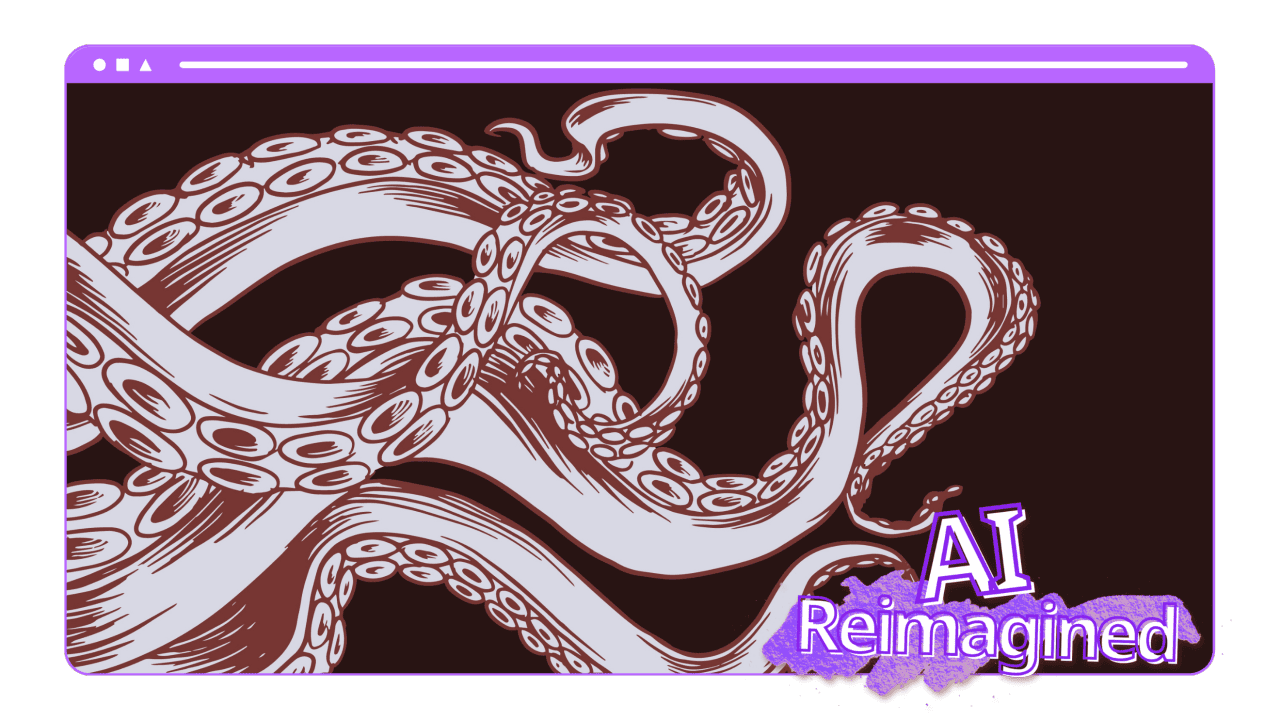
Nature already offers a model for this kind of learning. The octopus does not centralize intelligence. Most of its neurons live in its arms. Each arm perceives, tests, and adapts, learning locally while staying aligned to shared intent. The brain offers direction; the arms interpret reality.
An adaptive approach to AI works the same way. The center holds purpose, ethics, and coherence. The edges sense, experiment, and report back. Together they form a system that stays human-centred in a hyped world and still moves fast enough to survive and with discipline, to thrive.
When Plans Calcify Too Early
The desire for a roadmap comes from the desire for certainty: a hope that if we sequence things properly, the future will behave. AI makes that hope untenable. Capabilities shift monthly. Regulation evolves. Customer expectations advance. Entire business models appear or disappear in a single release cycle.
In conditions like these, long-range planning becomes a liability. It locks the business into assumptions that no longer match the market. Competitors do not pause for our plans; customers do not wait for our roadmaps to catch up. Organizations that stay competitive are not the ones that predict perfectly, but the ones that adjust decisively.
A retailer might discover that a simple AI-assisted replenishment tool reduces out-of-stock events within weeks. A bank may learn that underwriting consistency improves when teams feed local exceptions back into shared context layers. These kinds of early signals do more for strategy than any forecast.
The Octopus Model: A Clear Center, Autonomous Edge
Leading like an octopus is a structural response to volatility. The center concentrates on intent—the purpose that gives transformation direction—while the edges interpret the world and act on it.
The center defines what the work is in service of, what responsibilities guide it, what quality means, and how the emerging architecture should hold together. It becomes the custodian of clarity, not the choreographer of every move.
Edges operate with a different intelligence. They see friction before dashboards do. They notice shifts in customer behavior before strategy documents capture them. They surface gaps and contradictions no central plan predicts. Because they experience these signals first, they are best placed to respond.
Autonomy at the edges is not decentralization for its own sake. It recognizes that proximity to reality is a form of intelligence. This shared shape—purpose at the center, action at the edges—is what keeps the organization adaptive. Within it, a living feedback system becomes the connective tissue.
A Feedback System That Keeps the Body Aligned
In a distributed model, coherence comes from communication rather than control.
Insight must circulate: updates moving from the edges toward the center, and guidance flowing back into the work. Some of this is quiet and continuous: lightweight exchanges, visible work-in-progress, signals that help teams understand how their actions shape the system. Other moments require deliberate gathering: reflections where patterns become visible and direction can be chosen together.
Face-to-face moments serve a different purpose. They are cultural rituals, spaces to renew trust, strengthen identity, deepen alignment, and collectively sense what the organization is becoming. In those rooms, the architecture of the business and the architecture of its AI systems take clearer shape.
Measurement matters here. Leaders track whether decision quality is improving, whether cycle times are shortening, whether customers experience fewer delays or inconsistencies, and whether teams incorporate feedback faster. These indicators show whether learning is compounding.
Coherence is not imposed early. It appears over time, shaped through evidence and continuously evolved as the organization learns.
Designing Architecture Through Shifting Tides
Even adaptive organizations need architecture: a scaffold strong enough to hold coherence while everything around it moves. The mistake is believing that scaffold can be fully designed before teams begin experimenting.
In AI transformation, architecture emerges through motion. Teams test new workflows, automations, data pathways, evaluation methods, and interaction patterns. These experiments expose weaknesses and reveal new possibilities.
A logistics team might refine routing models after noticing that local constraints differ by warehouse. A call-center team might reshape escalation flows when AI highlights recurring customer confusion. As insights like these accumulate, the center assembles patterns: shared components, reusable capabilities, governance adjustments, and connective tissue the broader system can rely on.
The operating model becomes a living structure: shaped by evidence, refined through practice, and adjusted each time the organization understands itself more clearly. Done well, this is not drift. It is strategy rendered as infrastructure.
The People Layer: Leadership as Multiplication
Technology does not transform organizations. People do. And people change fastest when they are trusted to lead.
This requires a culture where leadership is multiplied, not concentrated, where those closest to the work take responsibility before they feel fully ready, supported by leaders who coach rather than direct. Coaching here is strategic. It sharpens judgment, builds confidence, and pushes learning upward rather than forcing instruction downward.
Mistakes are part of the design. Guardrails exist to preserve ethics, safety, and integrity, not to prevent experimentation. Within those boundaries, leaders grow by acting, trying, and adjusting. Each experiment becomes an apprenticeship in transformation.
Over time, this creates a leadership fabric: a distributed network of people who can sense, interpret, and respond without waiting for permission. In a market that rewards adaptability, that fabric is a core asset.
Transformation While Delivering the Present
AI transformation unfolds inside the live system of the business. There is no pause button. Teams must deliver revenue, support clients, operate services, and manage risk while reshaping the environment in which all that work happens.
The octopus model fits this reality. Teams learn while serving customers. They automate while meeting deadlines. They test ideas in the market while protecting trust.
A utilities provider refining outage predictions, a manufacturer tuning predictive maintenance at the line, or a professional services firm automating internal workflows—all while business continues—illustrate what this looks like in practice.
Transformation becomes part of the organization’s rhythm: not a detour from the work, but a new way of doing it.
The Transformational Cycle
AI transformation moves through a steady cycle. Teams sense the environment: friction that slows a workflow, shifts in customer behavior, gaps in context that lead systems astray. They act locally, running small experiments that reveal how the system responds. They reflect on what worked, what didn’t, and what questions emerged. The center adapts the operating model based on those insights. Only when patterns prove themselves in multiple contexts do they scale.
This is how an operating model grows in intelligence: not through prediction but through compounding insight.
Responsible AI as the Spine of Autonomy
Autonomy without responsibility destabilizes. Speed without ethics corrodes trust. Innovation without safeguards creates risks that are costly to unwind.
Responsible AI becomes the spine of adaptive transformation, not a compliance layer but a shared agreement about what the organization will not compromise. It shapes how experiments are designed, how data is handled, how decisions are interpreted, and how impact is weighed.
It does not slow the work. It ensures the work is worthy of scaling.
Transformation as a Living Organism
An octopus does not navigate the ocean by predicting every current. It moves by sensing, learning, and adjusting through a body designed for responsiveness. Its coherence comes from a center that understands intent and edges that interpret reality.
Enterprise organizations are no different. They do not exist for AI; they exist to compete, create value, and endure. AI matters only insofar as it strengthens those aims: reducing friction, sharpening decisions, opening avenues for growth, accelerating delivery, and building resilience where static models fail.
“AI transformation” is not a destination but a capability: the ability of a business to sense and respond to change faster and more coherently than competitors. It is strategy in motion: becoming adaptive, aligning what the business builds with how the world moves.
Organizations that do this well look less like machines and more like living systems. They keep purpose steady at the center and allow intelligence to accumulate at the edges. They use AI selectively—where it improves safety, judgment, efficiency, or customer experience—and avoid it where it creates noise or erodes trust. They refine their operating model through evidence, not aspiration, and invest in the people who carry that work forward.
They do not confuse motion with progress or scale prematurely. Instead, they create the conditions where insight compounds and the business grows sturdier with each cycle. AI is neither a threat nor a salvation. It is an amplifier of judgment, discipline, and clarity.
In a volatile world, transformation is not a phase or a slogan. It is a living system and its strength comes from the intelligence we distribute, the coherence we maintain, and the outcomes we choose to deliver.
#AILeadership #AdaptiveOrganizations #DigitalTransformation #FutureOfWork #BusinessStrategy #AITransformation #OperatingModels #ResponsibleAI #EnterpriseAI #LeadershipDevelopment
image by Freepik


